RU EN
Get tested

Multi-cancer early detection: a blood test that picks up the signal of early cancer

CA-62 is a multi-cancer early detection (MCED) blood test. Sensitivity for different types of early-stage cancer — 85–95%. The marker reflects tumour growth, not tumour size.

The world’s first multi-cancer (MCED) test system for detecting carcinomas with no restriction on tumour site to be authorised for use by a government authority: Roszdravnadzor certificate No. RZN 2020/9880 of 3 April 2020. Available at Citilab and DNKOM laboratories in 250+ cities across Russia.

Serum CA-62 level

Cut-off — 5,000 U/mL

≤ 5,000reference range for 95% of healthy individuals
> 5,000 U/mLA repeat blood test 30–60 days after the first helps distinguish a temporary rise from a persistent one.
An elevated CA-62 level alone is not a diagnosis. A physician interprets the result.

Cancer found early is treated far more successfully

The body recovers from many illnesses on its own, so we get used to waiting for them to pass. Conditions such as high blood pressure or diabetes need lifelong management. Many types of cancer can be cured if they are found early and treated promptly, according to the World Health Organization.

Early cancer is often painless and does not go away on its own. That is why it is important to look for it before symptoms appear.

How many people out of 10 live 5 years or more
  • Breast nearly all 3 out of 10
  • Prostate nearly all 4 out of 10
  • Kidney 9 out of 10 2 out of 10
  • Ovary 9 out of 10 3 out of 10
  • Colorectal 9 out of 10 2 out of 10
  • Lung 7 out of 10 1 out of 10

CA-62 detects 85–95% of cancers already at stage I–II — where the chances of cure are highest.

Five-year relative survival compared with people of the same age and sex without cancer, rounded to whole people out of 10; “nearly all” means the same as people without cancer. USA, SEER registry, 2016–2022.

CA-62 at a glance

85–95%

sensitivity already at stage I–II

95%

specificity — 95% of healthy people test within the normal range

6

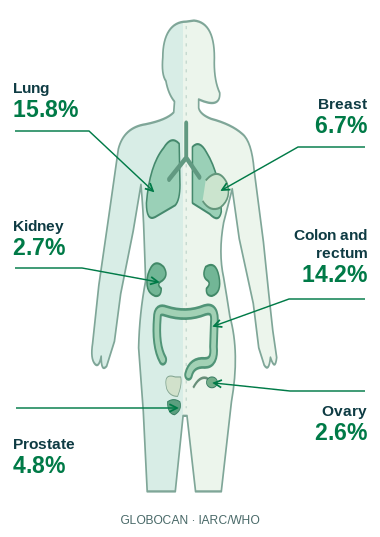
cancer types with statistically confirmed accuracy — together they account for nearly half of all cancer deaths in Russia*

Accuracy has been confirmed for six cancer types. Together they account for about half of cancer deaths in Russia.

These are the types with enough statistics so far, not the limit of the method. Early detection cases have been described across almost the entire tumour spectrum, including choroidal melanoma. Detection of sarcomas has not been observed. Well-differentiated tumours or tumours with a low rate of cell division, which are usually less aggressive, may be detected later, including at subsequent annual examinations.

* About 47% of cancer deaths in Russia: lung 15.8%, colorectal 14.2%, breast 6.7%, prostate 4.8%, kidney 2.7%, ovary 2.6%. Source: GLOBOCAN, IARC/WHO.

Share of cancer deaths in Russia for six cancer types. Lung 15.8%, colorectal 14.2%, breast 6.7%, prostate 4.8%, kidney 2.7%, ovary 2.6%.

How it works

CA-62 is a multiprotein marker of rapid division or intense metabolism in poorly differentiated cells. Its level may rise in the early stages of cancer.

  1. Living tumour cells release the marker.

    Cancer cells divide and metabolise an order of magnitude more intensively than normal cells. In the process, their membrane proteins with a distinctive N-glycosylation pattern continuously enter the blood — and these are what the test detects.

  2. So the signal is there at early stages

    The marker enters the blood as a result of cell activity, not cell death, and not in proportion to tumour size. Conventional tumour markers grow with tumour volume and often stay normal at early stages.

  3. A repeat test helps distinguish a temporary rise from a persistent one.

    Rapid division of the body’s own poorly differentiated cells also occurs without cancer: with inflammation, immune response, recovery from blood loss, pregnancy. Such rises pass, so a result above the cut-off is checked with a repeat test 30–60 days after blood collection.

Our track record

>10,000

tests performed

850+

medical centres

250+

cities in Russia where the test is available

6

pilot deployments in Russia, Kazakhstan, Canada and the USA

A simple, reliable way to check

Annual check-up

A yearly health check. The CA-62 signal supports the importance of additional tests, such as other tumour markers, and imaging examinations.

A normal result lowers the probability of aggressive cancer by about 10 times. Of 1,000 people around age 55, an estimated 10 have cancer. About one of those ten has a CA-62 level of 5,000 U/mL or less, so the test may miss their cancer that year.

Screening programmes

Narrows down risk groups and simplifies cancer detection in screening. Lowers spending on complex diagnostics by reducing the number of patients who need them.

Insurance programmes

When there is reason to suspect cancer, the programme sets out the next steps for assessment. This may reduce the insurer’s costs for diagnosis and treatment.

A technology first developed in Russia

CA-62 is the world’s first multi-cancer (MCED) test system for detecting epithelial carcinomas with no restriction on tumour site to be authorised for use by a government authority (Roszdravnadzor registration certificate No. RZN 2020/9880 of 3 April 2020). Carcinomas account for about 90% of all cancers. High sensitivity at stage I–II has been confirmed in blinded studies at Sechenov University.

Per the instructions for use: an auxiliary in vitro diagnostic method intended to help the physician make a medical decision. Share of carcinomas — per “Malignant neoplasms in Russia in 2024” (P. A. Herzen Moscow Oncology Research Institute).

Registration certificate
No. RZN 2020/9880
North America
Permitted for use in North America as an LDT since September 15, 2025.

Performed by a CLIA-certified laboratory in Montreal, Canada. LDTs are not cleared or approved by the U.S. Food and Drug Administration.

489patients with stage I–II cancer
141healthy participants

Blinded studies, Sechenov University, 2021–2022. Diagnostic performance established for 6 cancer types.
Clinical studies and screening experience

85–95%sensitivity
95%specificity
Publications and patents

CA-62 versus classic tumour markers

Sensitivity at 95% specificity, early stages, versus apparently healthy controls

Sensitivity of CA-62 and other markers at 95% specificity, by cancer type
Cancer typeMarkerSensitivity
Breast cancerCA-6293%
CA 15-338.5%
Lung cancerCA-6292.5%
CEA39%
CYFRA 21-115%
Prostate cancerCA-6290%
PSA20%
Colorectal cancerCA-6287%
CEA49%
Ovarian cancerCA-62 (> 5,000 U/mL)90%
CA-12556%
Kidney cancerCA-6295%

DNA-based multi-cancer tests in prospective studies

In a prospective study, thousands of people without symptoms give a blood sample and are followed for a year to see what share of all cancers diagnosed the test flagged in advance. This is the closest picture of real-world performance. For tumour-DNA tests, such data have been published:

  • 39.3%Galleri (Grail), PATHFINDER 2, 35,878 participants aged 50+, 2026. For the 12 deadliest cancers, 69.8%; specificity 99.6%.
  • 30.7%Galleri (Grail), NHS-Galleri, randomised trial, 142,250 participants aged 50–77, 2026. For 12 cancer types, 54.7%. The primary goal, fewer stage III–IV cancers, was not met.
  • 27.1%CancerSEEK, DETECT-A, 10,006 women with no history of cancer, 2020; specificity 98.9%.

Why. DNA tests look for fragments of tumour DNA in the blood. When a tumour is small, a blood sample may contain too few of these fragments to detect. The CA-62 test recognises distinctive sugar patterns on membrane proteins released by living, poorly differentiated cells. If the tumour cells have a high metabolic rate, even a small tumour may produce a detectable signal.

In a prospective study of patients with suspected lung cancer on CT, CA-62 was above 5,000 U/mL in 87.5% of early-stage cases. This is a different population, people already suspected of cancer rather than everyone screened, so the figures are not directly comparable.

Sources: PATHFINDER 2, ASCO 2026; NHS-Galleri, ASCO 2026; DETECT-A, Science 2020.

For physicians and clinics

CA-62 is a marker of poorly differentiated cells. Its level is associated with the division of these cells and the intensity of their metabolism, making the marker useful both for primary detection and for monitoring patients after treatment.

Target
Membrane proteins with a distinctive N-glycosylation pattern typical of poorly differentiated cells
Method
Competitive immunoassay with a single binding site, measuring the total serum level of these proteins
Scale
Competitive assay: the luminescence signal falls as antigen concentration rises — in the order of 10⁶ at ~1,000 U/mL and hundreds above 7,000 U/mL. Values of 4,500 and 5,500 U/mL differ in signal by about two orders of magnitude, so close-looking numbers are not compared directly; interpretation is threshold-based
Cut-off
5,000 U/mL — upper limit of the reference interval, inclusive; about 95% of healthy people fall within it
Spectrum
Accuracy statistically confirmed for 6 carcinoma types; detection cases described for most tumours, including choroidal melanoma. Detection of sarcomas has not been observed. Well-differentiated tumours or tumours with a low rate of cell division, which are usually less aggressive, may be detected later, including at subsequent annual examinations.
Result
The CA-62 test is intended to assist physicians in making medical decisions.

Questions to the developers and clinical discussion — Telegram chat for physicians t.me/EarlyDiagnosisPractice. Partnerships with clinics and requests for materials: info@oncomarker.ru. Publications and patents

Physicians sectionResult reference

Where to get tested

In Russia, the test is available through laboratory networks in more than 250 cities. Clinics and partners outside Russia — please contact us at info@oncomarker.ru.

from 8,000 RUBin Russia, before laboratory discounts

Interpreting the result

≤ 5,000 U/mL95% of healthy people have a result in this range.
> 5,000 U/mLConsult a physician. A new blood sample 30–60 days after the first can help distinguish temporary from persistent elevation.

An elevated CA-62 level alone is not a diagnosis. Your doctor considers your symptoms, past illnesses and the results of other tests.

Why CA-62 can rise without cancer

A temporary rise in CA-62 may occur with acute inflammatory and infectious diseases; exacerbations of chronic liver, lung or gastrointestinal disease; allergy, asthma and certain autoimmune diseases; pregnancy and breastfeeding; a recent vaccination; healing tissue; administration of immunogenic drugs or cell therapy; acute blood loss and other acute conditions.

Decrease during treatment

CA-62 can fall when treatment is working. Medicines that suppress the immune system or reduce blood cell production can also cause a drop. Your doctor assesses the reason for the change.

More on the CA-62 normal range and results

Questions about the CA-62 test

For physicians: test significance and reference tools

What is the CA-62 tumour marker?

CA-62 is a multiprotein marker of rapid division or intense metabolism in poorly differentiated cells. The test recognises characteristic changes in the N-glycan component — carbohydrate chains of different membrane proteins — as cells become poorly differentiated. Cancer cells release these proteins during their cellular activity, accompanied by more intense metabolism, so elevated CA-62 may be observed at early stages of cancer.

How should a CA-62 result be interpreted?

Up to and including 5,000 U/mL. Results of 95% of healthy people fall within this range. For a result above 5,000 U/mL: Consult a physician. A new blood sample 30–60 days after the first can help distinguish temporary from persistent elevation.

Can I compare two CA-62 results with each other?

Only with a physician. CA-62 is measured by a competitive assay: the more marker in the blood, the weaker the light signal the analyser reads. At around 1,000 U/mL the signal is in the order of a million light-signal units; above 7,000 U/mL it is only in the hundreds. So numbers that look close can differ greatly in signal: 4,500 and 5,500 U/mL differ in luminescence by about a hundredfold. A result is assessed against the 5,000 U/mL cut-off, and changes over time are assessed by a physician.

Does an elevated CA-62 mean I have cancer?

An elevated CA-62 level alone is not a diagnosis. Rapid division of naturally occurring poorly differentiated cells also takes place without cancer — during tissue repair, recovery from blood loss, development of an immune response and renewal of organ epithelia. Your doctor considers your symptoms, past illnesses and the results of other tests. Consult a physician. A new blood sample 30–60 days after the first can help distinguish temporary from persistent elevation. If your CA-62 level is high again, a chronic condition is more likely. This gives your doctor another reason to arrange further tests.

Does inflammation raise CA-62?

Not by itself. Rapid division of naturally occurring poorly differentiated cells also takes place without cancer — during tissue repair, recovery from blood loss, development of an immune response and renewal of organ epithelia. An elevated CA-62 level alone is not a diagnosis. Your doctor considers your symptoms, past illnesses and the results of other tests. So a temporary rise is possible with acute inflammation, infection or an exacerbation of a chronic disease. In chronic inflammatory diseases in remission, an elevated level occurs in no more than 5% of cases; in autoimmune diseases it is more common, up to half of cases (in psoriasis only in isolated cases). Consult a physician. A new blood sample 30–60 days after the first can help distinguish temporary from persistent elevation.

Should CA-62 be part of an annual check-up without symptoms?

Yes. Your CA-62 level alone cannot tell your doctor which organ to examine. The marker reflects the accumulation of cells with signs of poor differentiation and can point to a process before its location is known. It does not replace organ-specific examinations and tumour markers but complements them — these methods answer different questions. Among apparently healthy people, a result above 5,000 U/mL occurs in about 3% under 40, 5% at 45–60 and 6% over 55; Consult a physician. A new blood sample 30–60 days after the first can help distinguish temporary from persistent elevation.

How is CA-62 different from conventional tumour markers (CEA, CA 15-3, PSA)?

The signal of conventional tumour markers depends on tumour size, so they often stay normal at early stages. The CA-62 signal depends on the metabolic activity of tumour cells: an elevated level has been described with tumours as small as 5 mm. That is why CA-62 sensitivity is already high at stage I–II: 85–95% across six carcinoma types, compared with 15–56% for conventional markers in comparative data.

Which cancers does CA-62 detect?

Diagnostic accuracy is statistically confirmed for carcinomas of the breast, prostate, lung, ovary, kidney and colon/rectum, which together account for nearly half of all cancer deaths in Russia. Early detection cases have been described across almost the entire tumour spectrum, including choroidal melanoma. Detection of sarcomas has not been observed. Well-differentiated tumours or tumours with a low rate of cell division, which are usually less aggressive, may be detected later, including at subsequent annual examinations.

Who should take the CA-62 test?

The CA-62 test is intended to assist physicians in making medical decisions. The test may be used in initial examinations, annual health checks and occupational health examinations, as well as for monitoring during and after treatment. The need for testing and its results are assessed by a physician. CA-62 may therefore also be used to monitor patients during and after treatment, but changes in the marker must be assessed by a physician.

What does a result up to 5,000 U/mL mean?

A result of up to and including 5,000 U/mL lowers the probability of aggressive cancer by about 10 times. Of 1,000 people around age 55, an estimated 10 have cancer. About one of those ten has a CA-62 level of 5,000 U/mL or less, so the test may miss their cancer that year.

How much does the CA-62 test cost?

In Russia, from 8,000 RUB at partner laboratories, before discounts. Check the exact price on the laboratory's website.